Why On-Call and Surge Security Coverage Is Becoming a Standard for Well-Run Organizations
Security failures rarely make headlines because of dramatic external threats.
More often, they occur quietly, internally, and predictably.
An officer calls in sick.
A post goes uncovered.
A supervisor scrambles.
An exception becomes routine.
Risk quietly accumulates.
For organizations that already invest in security, these moments are not hypothetical. They are operational realities. And how leadership plans for them is increasingly a governance issue, not a scheduling one.
This is where security continuity and surge coverage enters the conversation.
The Hidden Fragility of “Fully Staffed” Security Programs
Many organizations believe they are secure because they have:
An internal security team
A contracted guard provider
Written post orders
Clear staffing requirements
On paper, this looks sufficient.
In practice, even well-run security programs are fragile when staffing is tight and margins for error are thin.
Most security teams operate with:
Minimal redundancy
High reliance on overtime
Limited bench strength
Supervisors doubling as line staff
This works until it does not.
The moment one absence creates a cascade of compromises, leadership is no longer managing security, they are managing risk exposure.
Staffing Gaps Are Not a Personnel Problem
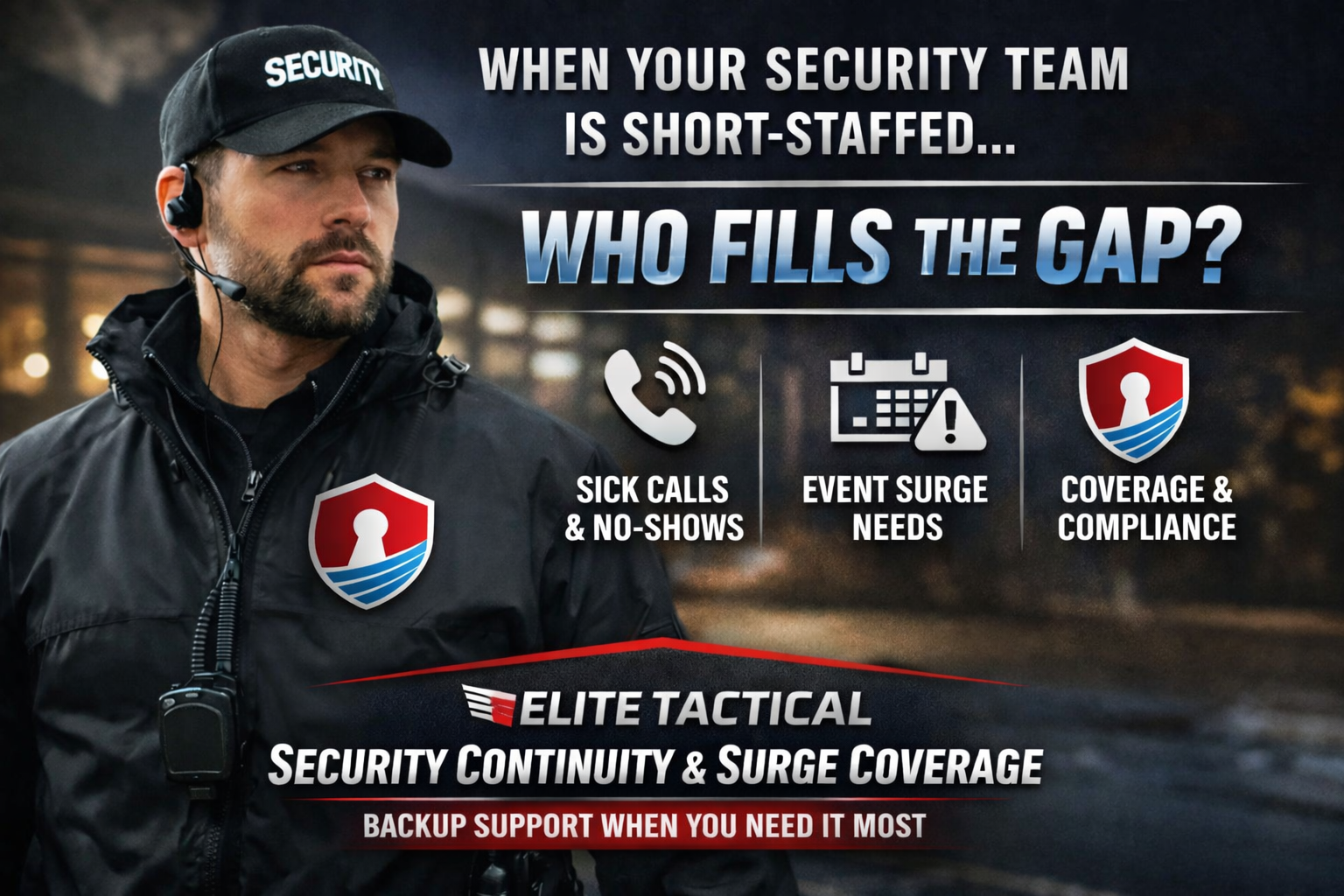
They Are a Systems Problem
From an executive perspective, staffing gaps should never be evaluated as isolated incidents.
They are indicators of system stress.
Consider the downstream effects of a single uncovered post:
Policy violations
Insurance exposure
Delayed response times
Reduced deterrence
Increased liability if an incident occurs
Erosion of confidence among employees, tenants, or customers
None of these risks are theoretical. They are well-documented in after-action reviews, litigation, and insurance claims across industries.
Security continuity planning exists to address this before leadership is forced into reactive decisions.
What Is Security Continuity and Surge Coverage?
Security continuity and surge coverage is a structured approach to ensuring that critical security functions remain uninterrupted, even when normal staffing fails.
Rather than relying on last-minute improvisation, organizations pre-arrange access to professional backup coverage that can be activated when needed.
This model provides:
On-call coverage for short-notice staffing failures
Supplemental officers for temporary increases in risk or activity
Planned surge staffing for events, construction phases, or operational changes
A controlled alternative to excessive overtime or post abandonment
It is not about replacing an existing security program.
It is about reinforcing it.
Two Use Cases Every Executive Recognizes
1. The Unplanned Disruption
Sick calls, no-shows, emergencies, and unexpected incidents are unavoidable.
What is avoidable is allowing those moments to:
Break policy
Create panic
Force leadership into unsafe decisions
On-call security continuity coverage ensures that when disruption occurs, response is immediate, professional, and predictable.
2. The Planned but Temporary Risk Increase
Organizations routinely experience periods of elevated exposure:
Special events
Construction milestones
Tenant transitions
Labor disruptions
Seasonal surges
Incident aftermaths
These do not always justify permanent staffing increases. But they do demand temporary reinforcement.
Surge coverage allows leadership to scale security responsibly without overcommitting resources long term.
Why This Matters at the Executive Level
From a C-suite perspective, security continuity intersects with several core responsibilities:
Risk Management
Unfilled security posts are not operational inconveniences. They are unmanaged risk.
Compliance
Many posts exist because they are required by contract, regulation, or insurer expectations.
Financial Stewardship
Uncontrolled overtime and crisis staffing are among the most expensive ways to manage security.
Organizational Resilience
Well-designed systems anticipate failure points and neutralize them before they escalate.
Security continuity planning reflects mature governance, not pessimism.
How Elite Tactical Approaches Continuity Differently
At Elite Tactical Security & Protection, continuity coverage is not treated as an afterthought or an upsell. It is treated as an operational discipline.
Our approach emphasizes:
Pre-defined activation procedures
Officers trained to integrate into existing environments
Clear communication with client leadership
Professional appearance and conduct that reflects positively on the organization
Documentation and reporting that supports accountability
The objective is not simply to “fill a spot.”
It is to preserve the integrity of the client’s security program.
Why Organizations Start Here and Go Further
Many of our most successful long-term partnerships begin with continuity or surge coverage.
Why?
Because these moments reveal:
How security providers perform under pressure
How they communicate with leadership
How well they understand the client’s environment
Whether they act as true partners or transactional vendors
For leadership, continuity coverage becomes a low-risk way to evaluate capability before making larger decisions about outsourcing, restructuring, or expanding security services.
A Strategic Way to Plan for the Unplanned
No organization expects staffing disruptions.
But every organization experiences them.
The difference between reactive security programs and resilient ones is simple:
Resilient programs plan for disruption before it happens.
Security continuity and surge coverage allows executives to:
Protect operations
Reduce liability
Control costs
Support internal teams
Demonstrate proactive governance
It is not about assuming failure.
It is about refusing to be surprised by it.
Next Steps for Leadership Teams
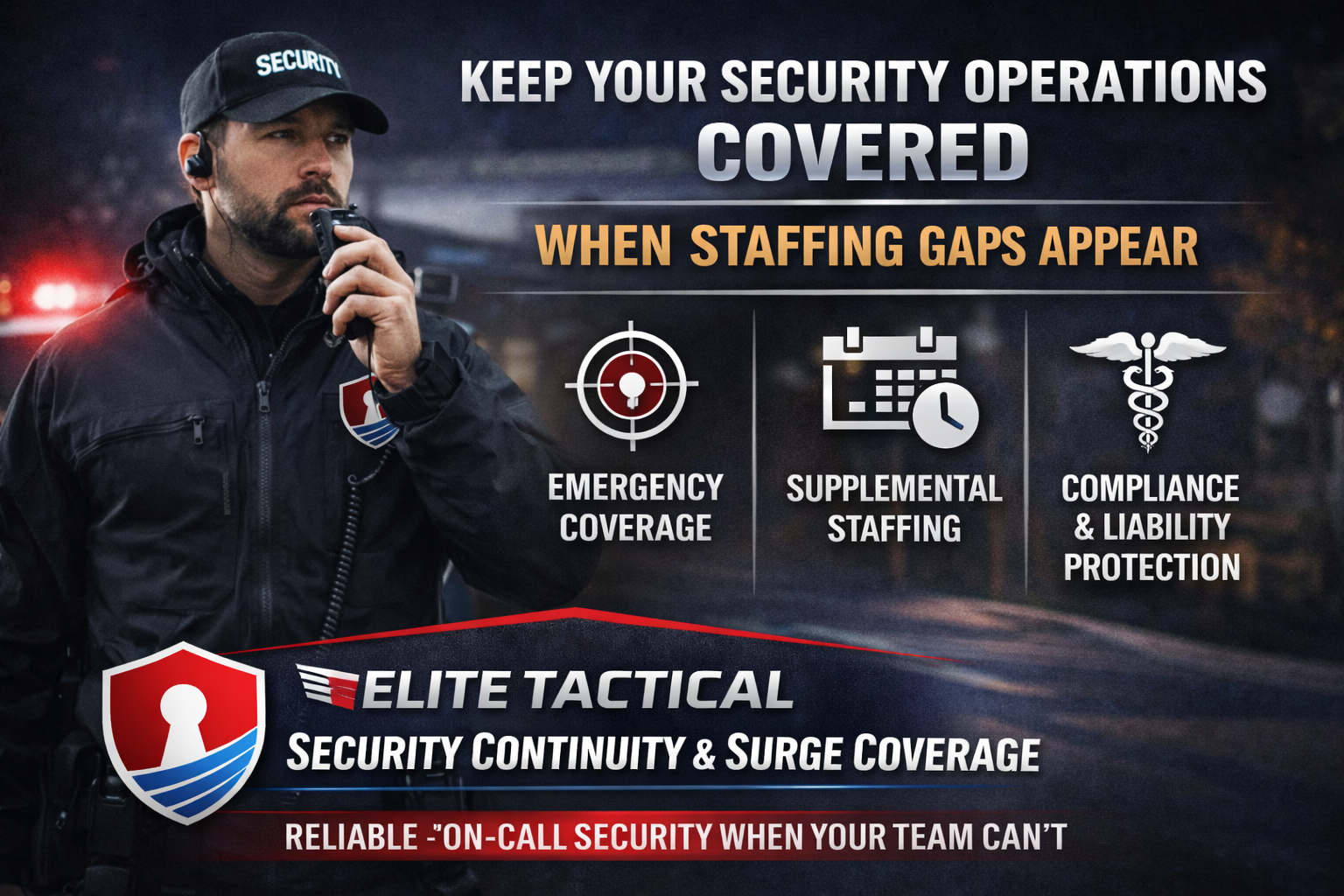
If your organization already has security in place and wants to explore:
On-call backup coverage
Surge staffing options
Continuity planning
Reduced reliance on overtime
Professional third-party reinforcement
Elite Tactical can design a continuity solution aligned with your operational, financial, and risk management goals.
The conversation does not begin with outsourcing.
It begins with continuity.
A Local Conversation About Security Continuity
Organizations across the Omaha metro area face a common challenge: maintaining consistent security coverage in an environment where staffing disruptions are inevitable and tolerance for risk is low.
For leadership teams responsible for commercial properties, construction projects, healthcare facilities, campuses, faith institutions, and mixed-use developments, security continuity is not a theoretical exercise. It is a practical governance decision that impacts operations, liability, and reputation.
Elite Tactical Security & Protection works exclusively with organizations that take a measured, professional approach to security planning. Our conversations with Omaha-area decision makers typically begin with one question:
“What happens to your security posture when something goes wrong on short notice?”
If your organization already has security in place and would like to explore:
On-call backup coverage for sick calls or no-shows
Surge staffing for temporary risk increases
Reduced reliance on overtime and last-minute improvisation
A structured continuity plan aligned with your existing operation
We invite you to have a brief, no-pressure conversation.
There is no obligation to change providers or outsource services. The goal is simply to determine whether a continuity and surge coverage model makes sense for your organization and to identify potential gaps before they become problems.
Security continuity is easiest to address before it is urgently needed.
Contact
For Omaha-area organizations interested in exploring security continuity and surge coverage, conversations typically begin with a short, practical discussion about existing staffing models, risk tolerance, and operational expectations.
Elite Tactical Security & Protection
Phone: 402-672-8871
Email: Contact@elitetacticaltransport.com
Whether your organization is evaluating backup coverage for occasional staffing gaps or planning for larger operational surges, we are available to discuss options that integrate cleanly with your current security program.
There is no obligation and no pressure to make immediate changes. The objective is clarity, preparation, and continuity.