
Professional Security Is More Than a Uniform
When businesses begin looking for professional security services, they are often responding to a specific concern.
There may have been a theft, an employee safety issue, repeated trespassing, damage to property, a disabled fire-protection system, or an upcoming event that requires additional planning.
However, effective security should not begin only after something has gone wrong.
A professional security program should help an organization identify risks, prepare for emergencies, protect employees and visitors, document concerns, and maintain normal operations.
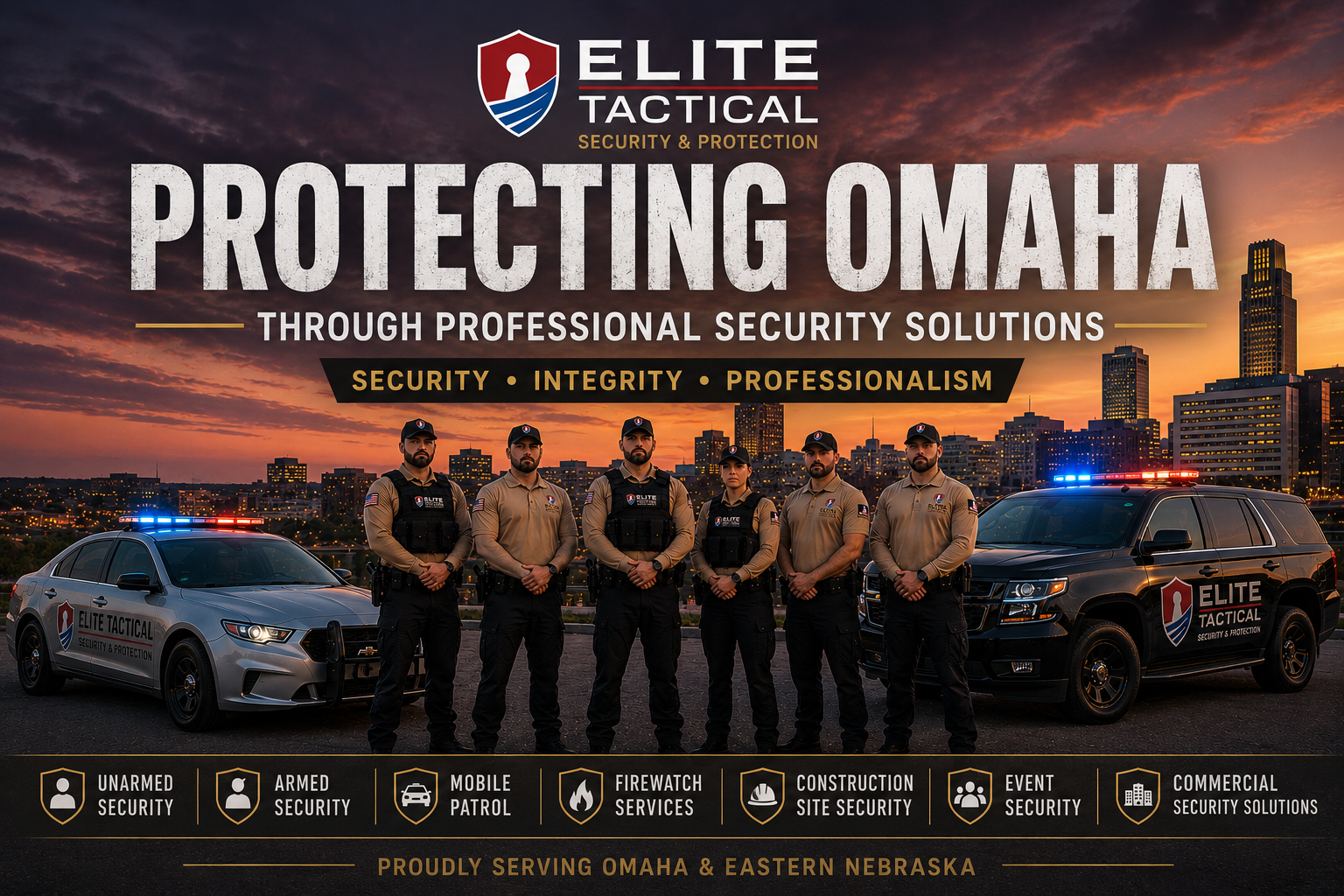
Elite Tactical Security & Protection is an Omaha-based security company providing customized security services for businesses, properties, events, nonprofit organizations, construction projects, and community partners throughout Nebraska.
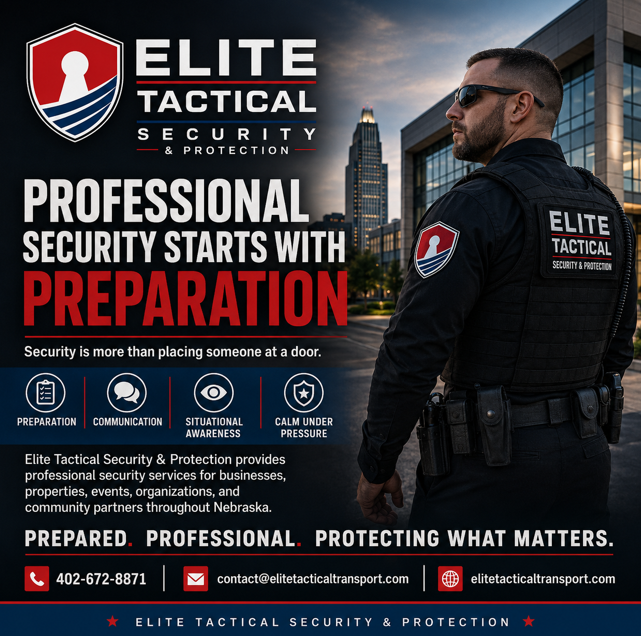
Our approach is built around preparation, professionalism, communication, and protecting what matters most to each client.
Every Organization Has Different Security Needs
There is no universal security plan that works for every property or event.
A construction site may need overnight equipment monitoring and perimeter patrols. A corporate event may require professional officers who can blend into the environment while remaining alert to potential concerns.
A commercial facility may need controlled access, employee escorts, incident documentation, or ongoing patrols. A building with an impaired fire alarm or sprinkler system may need immediate fire watch coverage.
The right security solution depends on several factors, including:
The type of property or operation
The number of employees, visitors, or guests
The hours the facility is occupied
Valuable equipment or information on site
Previous incidents or ongoing concerns
Emergency-response procedures
The level of visibility the client wants
The likelihood and potential impact of different risks
Elite Tactical works with clients to understand their environment before recommending coverage. Some assignments require a highly visible deterrent. Others require a discreet professional presence that supports the organization without disrupting it.
Security should fit the operation, not force the operation to fit the security provider.
On-Site Security Officers
A trained security officer can provide much more than a person standing near an entrance.
Depending on the assignment, an Elite Tactical officer may assist with access control, employee and visitor safety, property patrols, incident response, emergency communications, customer service, report writing, and coordination with law enforcement or emergency medical personnel.
A professional officer may also help identify smaller concerns before they develop into serious problems.
An unsecured door, suspicious vehicle, damaged light, blocked exit, water leak, unusual odor, escalating disagreement, or medical emergency can all require immediate attention.
The value of an on-site security officer is not limited to responding after an incident. A trained officer can observe changing conditions, communicate concerns, and take appropriate action while the situation is still manageable.
Armed and Unarmed Security Services
Some environments benefit from a professional unarmed security presence. Others may require armed security based on the property, operating conditions, client concerns, or level of risk.
Unarmed security officers can be effective in offices, residential communities, nonprofit facilities, medical environments, events, schools, commercial properties, and locations where customer service and professional interaction are important.
Armed security may be appropriate for higher-risk environments, sensitive operations, valuable assets, personal protection assignments, or facilities where a risk assessment supports an armed presence.
Carrying additional equipment does not replace judgment, communication, or restraint.
Professional armed security requires appropriate training, situational awareness, sound decision-making, and a clear understanding of the assignment. The objective is to protect people and operations while avoiding unnecessary confrontation.
Elite Tactical evaluates the needs of each client before recommending armed or unarmed coverage.
Event and Corporate Security
A well-managed event should feel safe, organized, and welcoming.
Guests should not feel that security is interfering with their experience. At the same time, event organizers need trained personnel who can recognize potential concerns, communicate with event staff, respond to emergencies, and help maintain a professional environment.
Elite Tactical provides event security for corporate gatherings, private functions, nonprofit events, community celebrations, leadership meetings, executive functions, festivals, and other special events.
Event security planning may include:
Reviewing the location and expected attendance
Identifying entrances, exits, and restricted areas
Coordinating with event organizers and venue personnel
Establishing emergency communication procedures
Preparing for medical, fire, weather, and security incidents
Managing access to private or controlled areas
Providing a visible or discreet security presence
Documenting significant incidents or concerns
The best event security operations are often the ones guests barely notice because everything runs smoothly.
Fire Watch Services
When a fire alarm, sprinkler system, fire pump, or other fire-protection system is impaired, a property may need trained personnel to conduct a fire watch.
Fire watch is not simply sitting inside a building until the system is restored.
A professional fire watch may require regular patrols, inspection of designated areas, identification of fire and life-safety hazards, accurate documentation, immediate reporting of dangerous conditions, and a clear procedure for contacting emergency services.
Elite Tactical provides fire watch services for commercial buildings, apartment properties, warehouses, construction projects, health care environments, offices, and other facilities.
Organizations should develop a fire watch plan before an emergency occurs.
Knowing who to call, what areas must be inspected, how patrols will be documented, and how quickly coverage can begin may prevent delays, confusion, and expensive emergency arrangements.
Elite Tactical can help businesses prepare for both planned system outages and unexpected impairments.
Property Patrol and Construction Security
Not every location requires a dedicated officer throughout the entire day.
Scheduled or randomized patrols may be a practical option for offices, apartment communities, retail properties, vacant buildings, warehouses, and commercial facilities.
Patrol services may include checking doors, parking areas, exterior conditions, lighting, suspicious activity, unauthorized occupants, and other client-specific concerns.
Construction sites face a different set of risks.
Tools, equipment, fuel, copper, building materials, and machinery can become targets for theft or vandalism. Unfinished structures may also create hazards involving trespassers, open areas, temporary utilities, and changing site conditions.
Elite Tactical can provide construction-site security, access control, overnight observation, equipment monitoring, patrols, and incident documentation.
Addressing security early in a project may reduce losses, delays, insurance concerns, and disruptions to the construction schedule.
Training Creates Better Security Officers
A uniform does not automatically make someone prepared.
Security officers need training that reflects the real situations they may encounter while protecting a client.
Elite Tactical emphasizes professional development in areas such as:
De-escalation
Situational awareness
First aid and emergency response
Stop the Bleed
Fire watch procedures
Radio communication
Access control
Report writing
Professional conduct
Incident recognition and documentation
Training gives officers a foundation for making better decisions.
It helps them recognize emergencies, communicate clearly, maintain control of their own behavior, and respond appropriately when conditions change.
Security officers are frequently among the first people to encounter an injured person, escalating conflict, suspicious activity, fire alarm problem, or other emergency. Their ability to remain calm and take reasonable action can significantly affect the outcome.
De-Escalation and Professional Communication
Professional security is not about creating confrontation.
In many situations, the most effective response begins with calm communication, active listening, clear boundaries, and an understanding of how behavior may escalate.
De-escalation training helps officers recognize warning signs and respond without making the situation worse.
A professional officer should know when to speak, when to listen, when to create distance, when to request assistance, and when emergency services are needed.
This protects the officer, the client, employees, guests, and members of the public.
The goal is not to win an argument. The goal is to resolve the concern safely and professionally.
Accurate Reporting and Accountability
Security reports may become important business, insurance, legal, or law-enforcement records.
Reports should be timely, accurate, objective, and detailed enough to explain what occurred.
Statements such as “everything was fine” or “there was an incident” do not provide clients with meaningful information.
Professional documentation should identify what the officer observed, what actions were taken, who was notified, and how the situation was resolved.
Elite Tactical emphasizes reporting because clients deserve accountability and useful information about their security operations.
Clear documentation can also help organizations identify patterns, evaluate recurring concerns, improve procedures, and make better decisions about future security needs.
Technology Supports Security, but It Does Not Replace People
Cameras, alarms, access-control systems, and other security technologies are valuable tools.
However, technology has limitations.
A camera can record an incident, but it cannot assist an injured employee. An alarm can signal a problem, but it cannot determine what is happening or provide directions to responding personnel.
Technology may not be able to de-escalate a conflict, check an unsecured door, move people away from danger, identify a developing hazard, or provide reassurance during an emergency.
The strongest security programs combine trained personnel, effective technology, clear procedures, and reliable communication.
Locally Owned and Focused on Nebraska
Elite Tactical Security & Protection is proud to be based in Omaha.
We understand that local businesses and organizations need a security partner who is responsive, professional, and familiar with the communities they serve.
Our goal is not to provide a generic officer and move on to the next assignment.
We want to understand the client’s operation, identify practical security needs, establish clear expectations, and build a dependable working relationship.
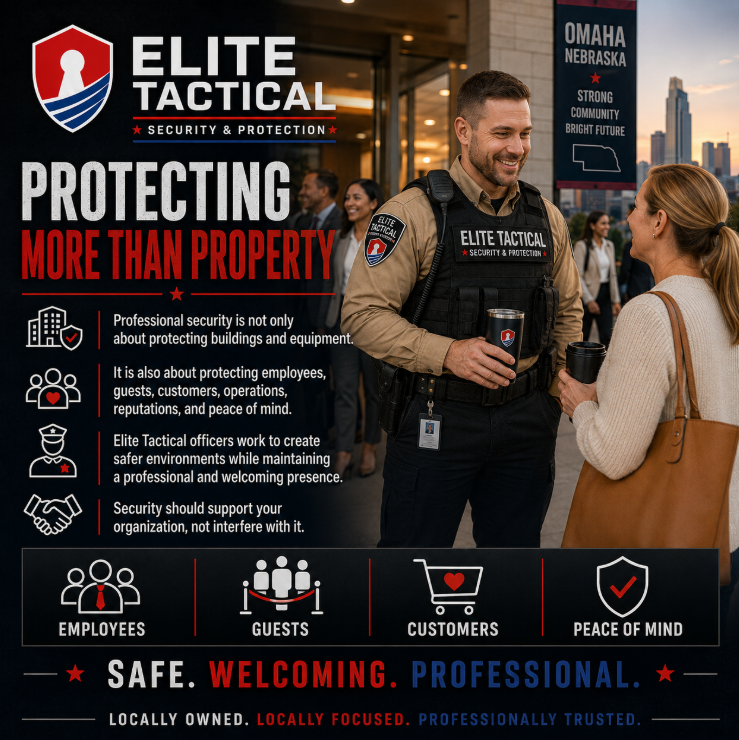
Professional security should support your employees, customers, guests, property, operations, reputation, and peace of mind.
Start a Conversation About Your Security Needs
You do not need to know exactly what type of security service you need before contacting Elite Tactical.
Tell us about your property, event, organization, operating hours, or concerns. We can help evaluate the situation and discuss practical options.
Elite Tactical Security & Protection provides professional security services throughout Omaha and communities across Nebraska.
Services include:
Armed and unarmed security officers
Event and corporate security
Property patrols
Construction-site security
Fire watch services
Secure transportation and escorts
Customized security planning
Emergency-preparedness and security training
Contact Elite Tactical Security & Protection:
402-672-8871
contact@elitetacticaltransport.com
elitetacticaltransport.com
Prepared. Professional. Protecting what matters.
#EliteTactical #OmahaSecurity #NebraskaSecurity #ProfessionalSecurity #FireWatch #EventSecurity